Sustainability Solution Comparison - B2B SaaS
Sustainability Solution Comparison - B2B SaaS
A comparison flow that turns 20+ min of spreadsheet fatigue into a 6-min decision.
CLIENT
ESGentle
Role
Product Designer
TIMELINE
3 Months
PLATFORM
Responsive Web
TEAM
1 Product Designer,
1 Full-Stack Developer,
1 Sustainability Advisor,
1 CEO
Outcome
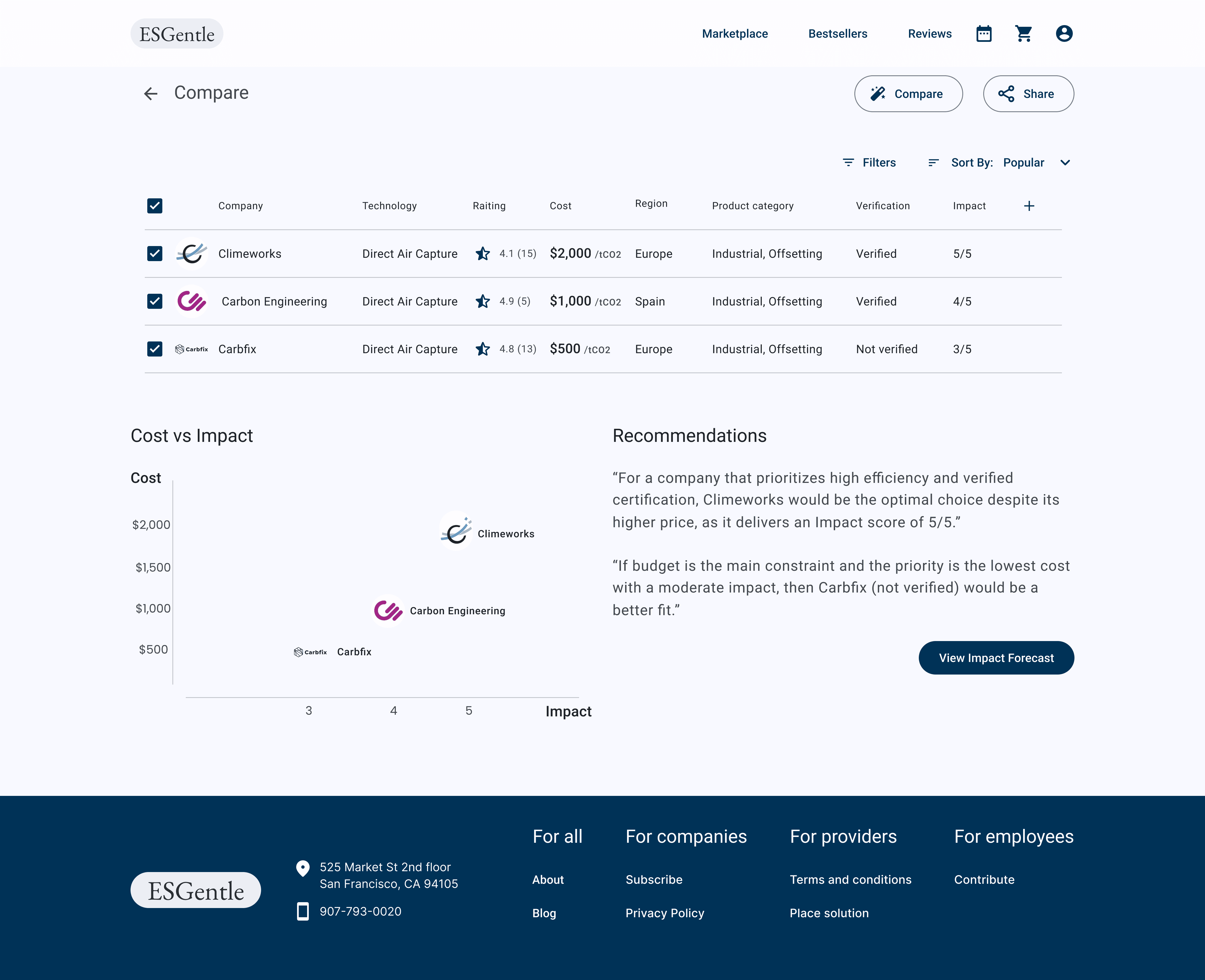
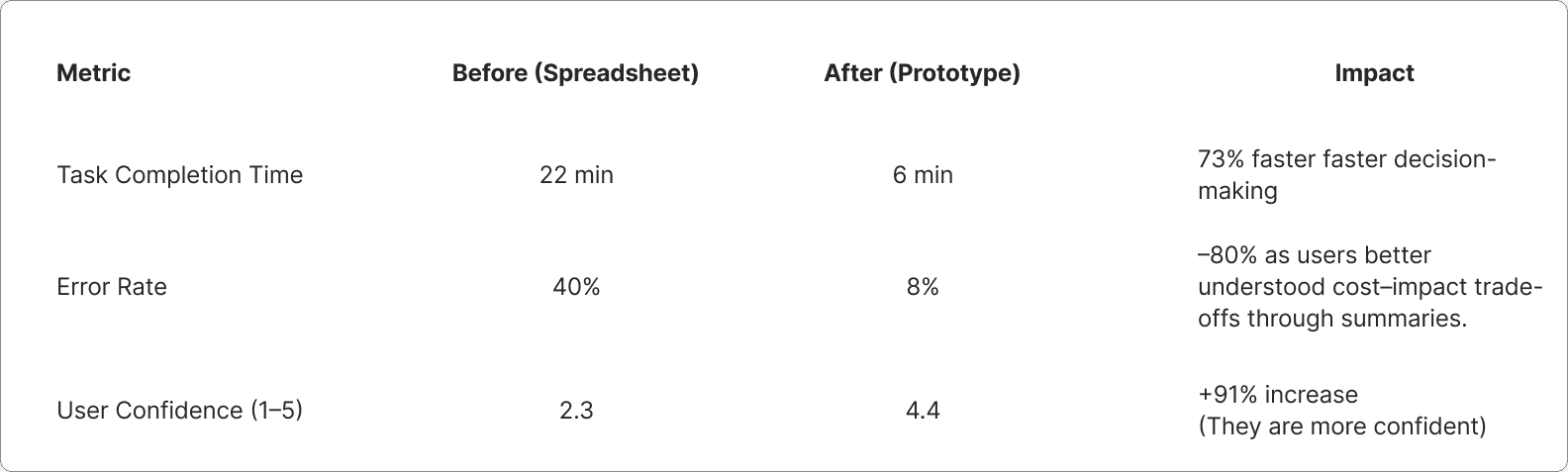
The redesigned comparison experience allowed sustainability managers to make confident purchasing decisions in under 6 minutes instead of 22.
Error rate in interpreting cost-to-impact data dropped from 40% to 8%, proving that simplified data visualization improved comprehension.
User confidence in decision-making increased from 2.3/5 to 4.4/5, as participants trusted the results and logic of the comparison flow.
Engagement metrics from prototype testing showed 90% feature interaction and 70% exploration of multiple scenarios, confirming strong user adoption potential.
Drop-offs within the comparison flow were reduced by 30 percentage points (45% → 15%), validating the simplified 5-step journey.
The prototype was approved for development by stakeholders after demonstrating measurable ROI and usability impact prior to build.
Outcome
The redesigned comparison experience allowed sustainability managers to make confident purchasing decisions in under 6 minutes instead of 22.
Error rate in interpreting cost-to-impact data dropped from 40% to 8%, proving that simplified data visualization improved comprehension.
User confidence in decision-making increased from 2.3/5 to 4.4/5, as participants trusted the results and logic of the comparison flow.
Engagement metrics from prototype testing showed 90% feature interaction and 70% exploration of multiple scenarios, confirming strong user adoption potential.
Drop-offs within the comparison flow were reduced by 30 percentage points (45% → 15%), validating the simplified 5-step journey.
The prototype was approved for development by stakeholders after demonstrating measurable ROI and usability impact prior to build.
Context & Problem
Managers choosing CO₂-reduction solutions were drowning in data — rich tables, no clear answer. They abandoned the flow after 3–4 steps, spent 20+ minutes, and rarely reached a confident decision.
The goal: compare solutions by price, impact, and ROI and get a data-driven answer in a few clicks.
Research
Quantitative Research (Behavioral Analytics)
users dropped off after 3–4 steps;
the table was too complex and data-heavy — 20+ minutes without a confident decision.
Qualitative Research (User Interviews)
managers wanted actionable guidance, not raw data — clarity, time savings, and report-ready outputs.
Process
User journey
Simplified a 9-step journey into 5
Flow Highlights:
Select 2–5 solutions
AI-generated comparison table
AI recommendation summary
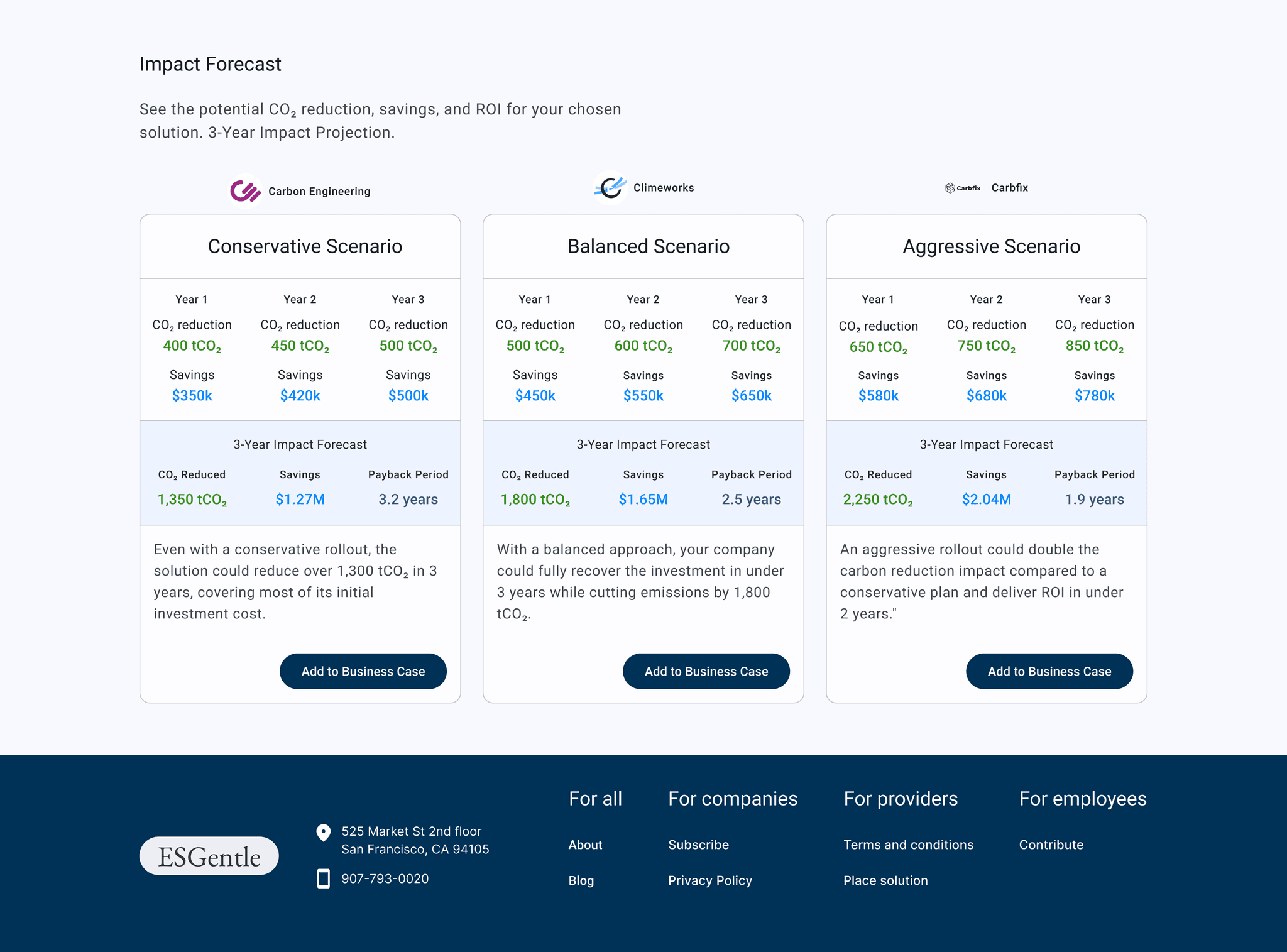
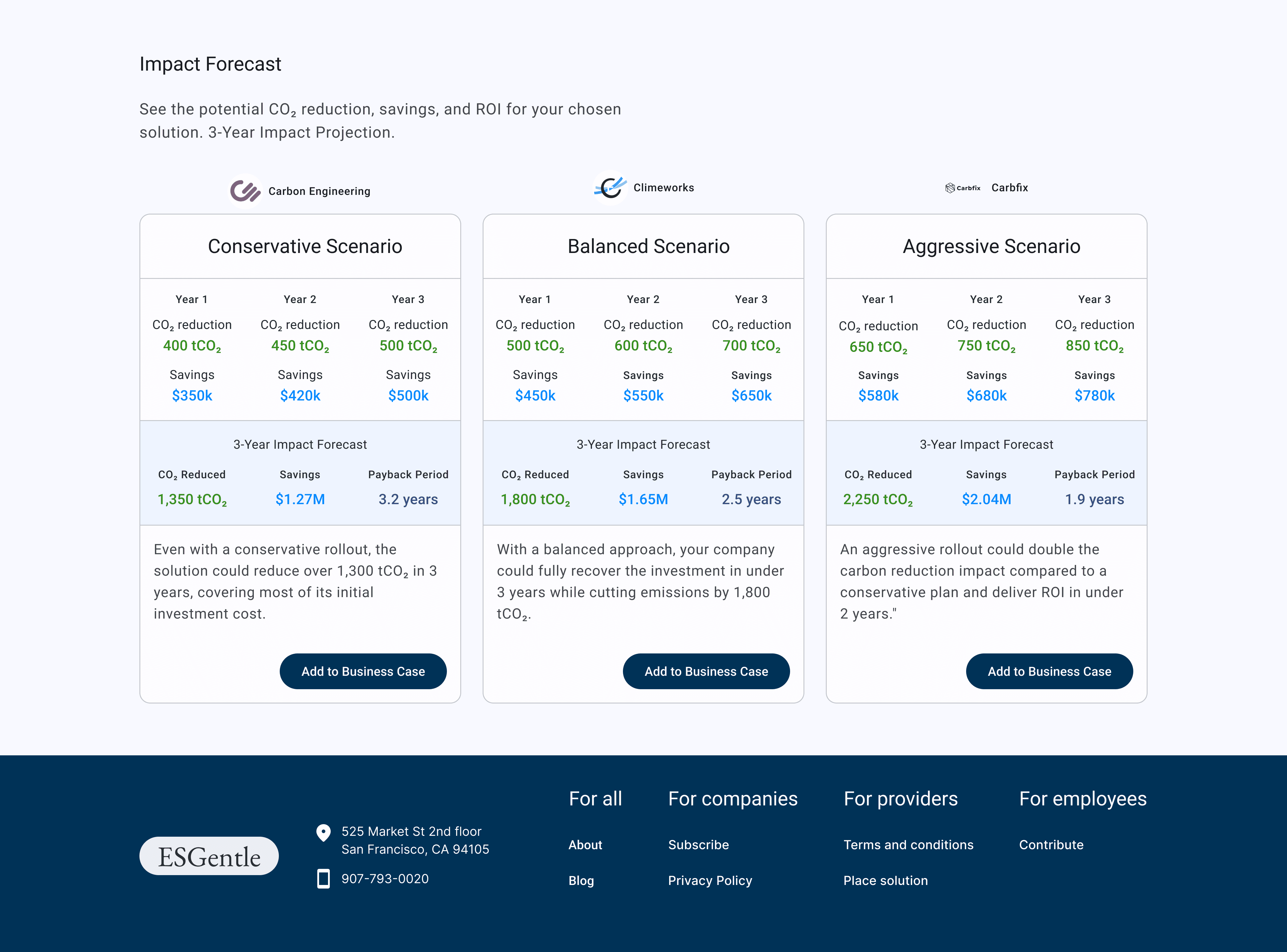
3-year impact forecast (Conservative / Balanced / Aggressive)
Export as a business case
Solution
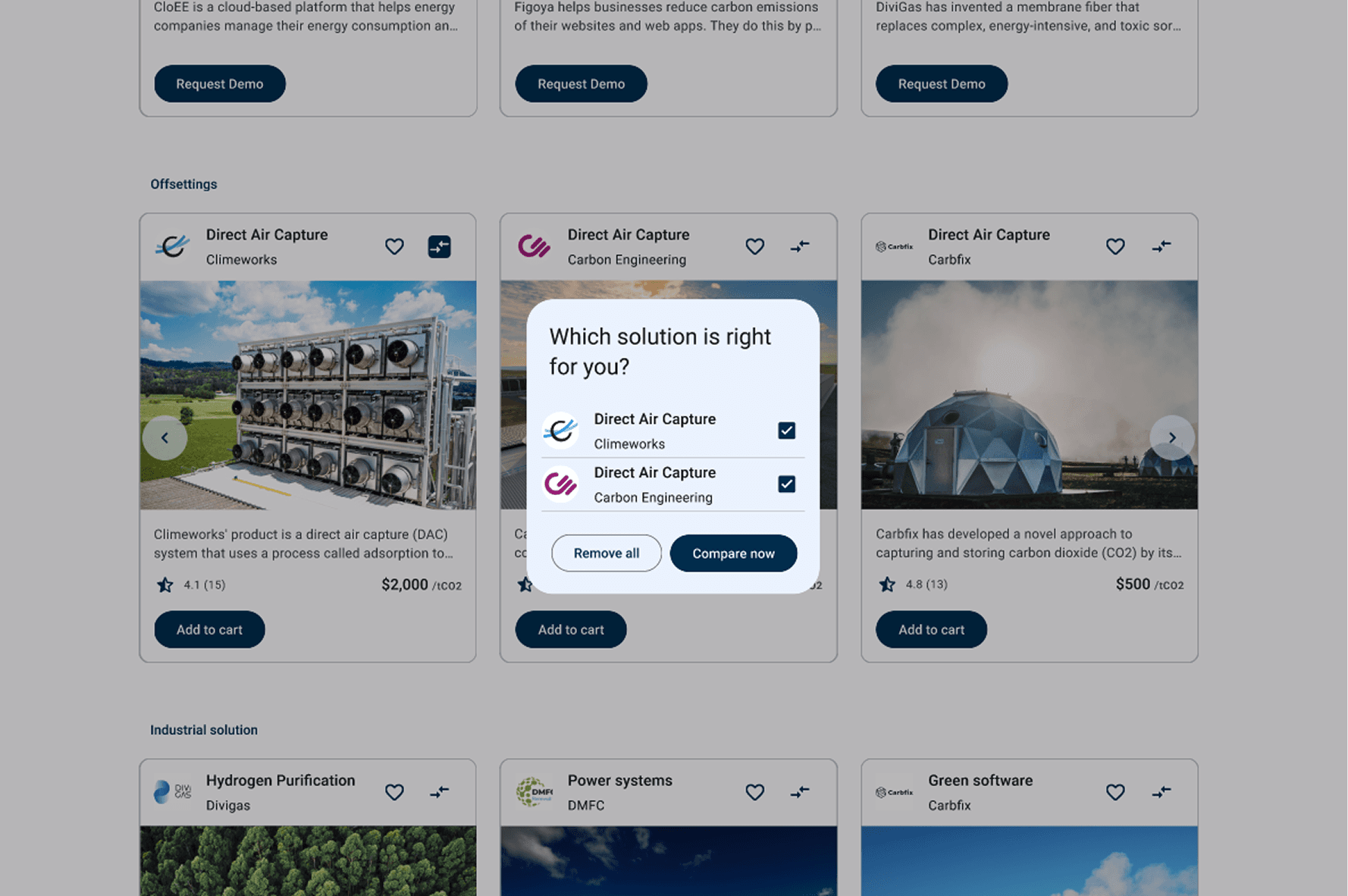
Selecting ESG Solutions to comparison table
Comparison table formation with recommendations
3-Year impact forecast with scenario selector, and "Add to Business Case"
Usability tests
Validate efficiency and clarity of the prototype
Outcome
Decision time
22 → 6 min (73% faster)
Cost-to-impact interpretation errors
40% → 8%
Decision confidence
2.3 → 4.4/5
Flow drop-off
45% → 15%
Prototype analytics
90% used the Recommendation button 70% explored multiple scenarios
Prototype approved for development
pre-build on measurable ROI
Takeaway
When data is dense, the design job is synthesis, not subtraction. Turning a 9-step compare into a 5-step decision is what made managers trust the numbers.
Impact
Usability tests
Task Success Rate
80% (user testing)
Time-to-decision
↓ 30%
Validate efficiency and clarity of the prototype
Solution
Selecting ESG Solutions to comparison table
Comparison table formation with recommendations
3-Year impact forecast with scenario selector, and "Add to Business Case".
When data is dense, the design job is synthesis, not subtraction. Turning a 9-step compare into a 5-step decision is what made managers trust the numbers.
Takeaway
Solution
Selecting ESG Solutions to comparison table
Comparison table formation with recommendations
3-Year impact forecast with scenario selector, and "Add to Business Case".
Next Projects
Next Projects
Next Projects
Usability tests
Validate efficiency and clarity of the prototype
When data is dense, the design job is synthesis, not subtraction. Turning a 9-step compare into a 5-step decision is what made managers trust the numbers.
Takeaway
Context & Problem
Managers choosing CO₂-reduction solutions were drowning in data — rich tables, no clear answer. They abandoned the flow after 3–4 steps, spent 20+ minutes, and rarely reached a confident decision.
The goal: compare solutions by price, impact, and ROI and get a data-driven answer in a few clicks.
Research
Quantitative Research (Behavioral Analytics)
users dropped off after 3–4 steps;
the table was too complex and data-heavy — 20+ minutes without a confident decision.
Qualitative Research (User Interviews)
managers wanted actionable guidance, not raw data — clarity, time savings, and report-ready outputs.
Process
User journey
Simplified a 9-step journey into 5
Flow Highlights:
Select 2–5 solutions
AI-generated comparison table
AI recommendation summary
3-year impact forecast (Conservative / Balanced / Aggressive)
Export as a business case
Outcome
Decision time
22 → 6 min (73% faster)
Cost-to-impact interpretation errors
40% → 8%
Decision confidence
2.3 → 4.4/5
Flow drop-off
45% → 15%
Prototype analytics
90% used the Recommendation button 70% explored multiple scenarios
Prototype approved for development
pre-build on measurable ROI
Outcome
Decision time
22 → 6 min (73% faster)
Cost-to-impact interpretation errors
40% → 8%
Decision confidence
2.3 → 4.4/5
Flow drop-off
45% → 15%
Prototype analytics
90% used the Recommendation button 70% explored multiple scenarios
Prototype approved for development